
When you hear the word warranty, your mind probably jumps to physical products—smartphones, washing machines, or your car. It’s a safety net: if something breaks unexpectedly, the manufacturer either fixes it or replaces it.
But what happens when what’s at risk isn’t a physical object, but your data, your operations, your entire digital presence?
That’s where cyber warranty services come into play. At first glance, it might sound like a digital version of a product warranty. But in reality, cyber warranties are built on an entirely different premise. They’re not just about repairs—they’re about prevention, detection, and fast recovery in the face of cyber threats.
Let’s unpack the fundamental differences between cyber warranty services and traditional product warranties.
Tangible vs. Digital Protection
Traditional product warranties typically cover hardware or tangible goods. When you buy a new laptop, the company will replace it if the screen fails within the warranty period. It’s about physical faults, manufacturing defects, and product performance.
Cyber warranties, on the other hand, are entirely rooted in digital risk. They’re designed to respond to incidents like ransomware attacks, unauthorized access, data breaches, or even accidental leaks.
These aren’t about broken components—they’re about digital exposures, vulnerabilities, and the financial and reputational damage they cause.
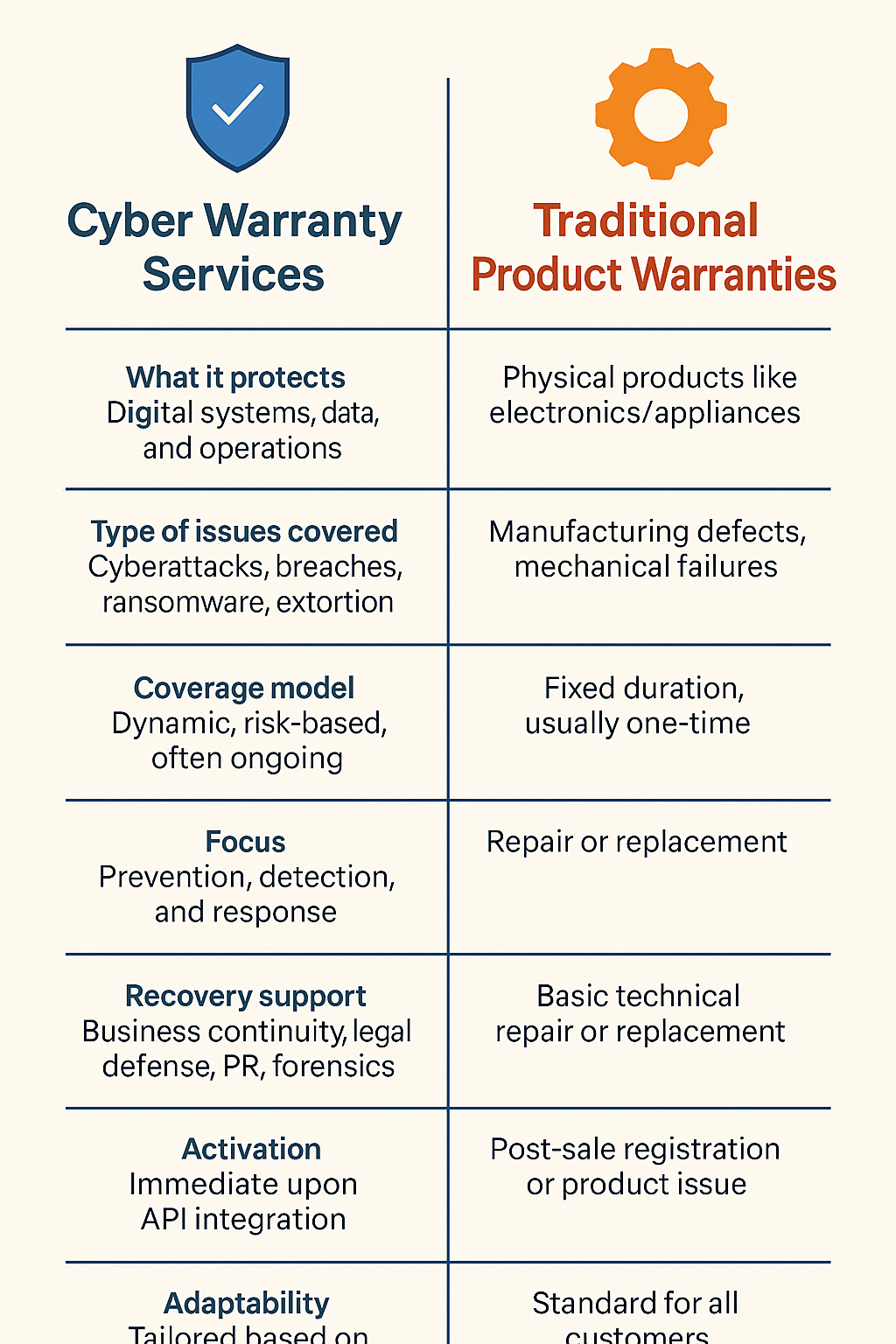
A Quick Comparison: Cyber Warranty vs. Product Warranty
Here’s a snapshot of how these two warranty models differ:
One-Time Coverage vs. Ongoing Security Assurance
Product warranties are typically static. You get coverage for a fixed period—one year, maybe two. After that, you’re on your own, unless you opt for an extended plan. There’s no interaction between the manufacturer and the product once it leaves the shelf, until a problem arises.
Cyber warranties, however, are dynamic and proactive. They often require continuous monitoring of your cybersecurity systems. At DLT Alert, for instance, coverage is triggered once your systems are connected to our platform via API—a process that takes less than a minute.
From there, we don’t just offer coverage; we support real-time threat detection and risk scoring to help prevent attacks before they occur.
In this way, cyber warranties behave more like a partnership than a policy.
Repairs vs. Risk Mitigation
The core function of a traditional product warranty is repair or replacement. If the product fails under normal use, the company fixes it. There’s usually no involvement in how you use the product or how to prevent damage from happening in the first place.
With cyber warranty services, the story is different. It’s not just about covering losses after a breach—it’s also about reducing the likelihood of the breach ever happening. These services often come bundled with cyber hygiene tools, employee awareness training, and even 24/7 threat detection systems.
The focus shifts from compensation to resilience.
This shift is especially important for small and mid-sized businesses that can’t afford a full-blown internal cybersecurity team.
Financial Limits vs. Business Continuity
Traditional warranties offer limited protection. You may be entitled to a replacement or refund, but a product warranty typically does not cover any indirect losses—such as time lost, business downtime, or reputational harm.
Cyber warranty services, in contrast, are built around the idea of business continuity. When a cyber incident happens, it’s not just about fixing one thing—it’s about keeping your entire operation running. This might involve ransomware payment assistance, forensic investigations, crisis communications, legal defense, or third-party liability protection.
These warranties are increasingly seen as an extension of your broader cybersecurity and insurance strategy.
One Size Fits All vs. Custom-Tailored Risk Models
Product warranties tend to be universal. Everyone who buys the product gets the same coverage terms, regardless of how or where they use it.
Cyber warranties are much more nuanced. Coverage is often calculated based on your risk profile, which includes your industry, the size of your business, your cybersecurity posture, and the level of integration between your systems and the warranty provider’s technology.
At DLT Alert, for example, real-time risk scoring and continuous posture updates help determine the level of protection you receive and how you’re supported during an incident.
This tailored approach ensures you’re not overpaying—or worse, under-protected.
Why This Difference Matters in Today’s Threat Landscape
Cyberattacks don’t care about business hours or your IT staff’s availability. They strike fast, often in the dead of night, and the damage can snowball within minutes. In such an environment, waiting for a traditional insurance claim or reacting after the fact just isn’t enough.
That’s why cyber warranties are reshaping how organizations think about cybersecurity. They don’t just back you up after an attack—they help you stay ahead of one.
With ransomware damages projected to exceed $275 billion by 2031, and with 43% of all cyberattacks targeting small businesses, this shift from reactive insurance to proactive warranty is more than just a trend—it’s a necessity.
The Bottom Line
While product warranties and cyber warranties may share a name, they operate in completely different worlds. One protects physical goods after they fail. The other protects digital infrastructure before, during, and after a cyber incident.
At DLT Alert, we believe businesses shouldn’t have to choose between cybersecurity and affordability. Our cyber warranty services are built to provide real-time support, automated protection, and immediate coverage that activates in under a minute.
So, the next time you think about warranties, don’t just think about your gadgets—think about your data, your network, and the future of your business.
Got 30 seconds? Watch this quick FAQ: What is covered by the warranty?
Also Read: Cyber Warranties: The Future of Comprehensive Digital Protection